
Parts used:
- eVGA e-GeForce 8800 GTS 320 Mb Superclocked Graphics Card (Nvidia based).
I am not interested at all in the very high end where you buy two video cards -- my experience with video card drivers, video card failures, and video cards quickly being obsolete and requiring replacement means that the thought of dealing with twice the trouble is just out of the question. These puppies also use a lot of electrical power and generate a lot of heat, even one card can be a handful. Plus, it seems like a "workaround" that has been institutionalized (the expression is "paving cow paths"). It doesn't seem very elegant to have to run two cards and I have a vague suspicion that the video card vendors push the idea even if it is not the best solution, wouldn't you if selling video cards was your business?. Anyway, since it is my computer I get to build it my way - that means one video card :-).
The other two big factors in my graphics card selection are that I only need it to run at my current LCD display's native resolution which is 1280 x 1024 pixels. And I don't want to spend more than about $250 on a card. So the decision, which could have been tough, was actually easy, I would get the "baby" card in Nvidia's 8000 series, one with only 320 Mb of memory since that is enough to run my LCD and bring the price down to very close to my budget target. Budgets are only targets after all, not laws.
The card I installed is from a well-known manufacturer called eVGA. It is a slightly overclocked card from the "factory". I don't think it is too common to get a card that is overclocked from the factory, but this one is, and it has a very good warranty, and it has good user reviews on Newegg. It is physically big and takes two slots. It needs a fair amount of electrical power and cooling but I have plenty of both!
The card runs in a x16 (times 16) PCI express bus which is what the Gigabyte motherboard has. It has Microsoft DirectX 10 support which is the latest piece of software in Microsoft's operating systems (needed soon for the latest games, not yet but coming) -- and you can only run DirectX 10 in Vista. The eVGA card is "built for Windows Vista" according to eVGA.
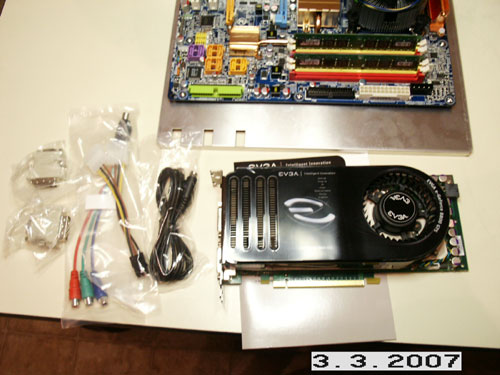
The eVGA 8800 GTS 320Mb graphics card.
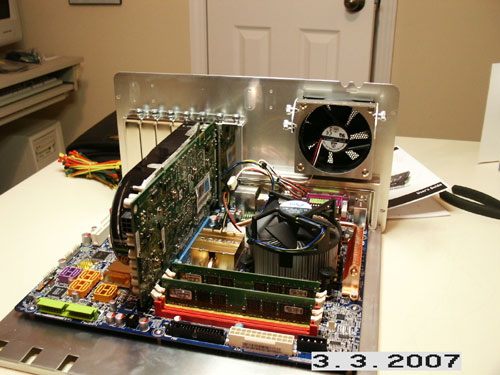
Notice the thumb screws on the PCI port covers, more Lian Li attention to detail. It is starting to look like a PC! You can see how the motherboard standoffs lift the board off the tray a little.
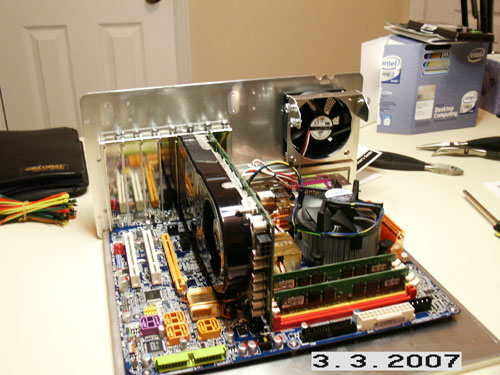
Note: there is a small plastic latch on the end of the PCIe slot that has to lock the card in place. Look at all the fans. There are 3 visible just on the motherboard tray, one for the case, one on the CPU and one in the graphics card! And they aren't tiny - am I building a PC or a heater?